
Cyclone build part 2 – Air Inlet and Ramp
Before we go on to the main upper body of the cyclone, lets get the air ramp and air inlet ready for it. The air inlet is a rectangular section passage which fires the dust laden air into the main cyclone. The angle at which it does this is crucial (something many commercial cyclones ignore). It wants to be sloping downwards, at the outside edge of the upper body. The inlet needs to be a certain length of straight smooth passage, so that the air entering the cyclone is in a nice turbulent-free stream.
As Pentz explains, horizontal inlets are one of the main culprits, when it comes to unwanted turbulence inside a cyclone:
The turbulence inside a normal cyclone is so high it keeps these particles airborne and separates almost 0% of the airborne dust particles sized much under about 25 to 30-microns.
Having the inlet tall but narrow helps keep the dust and particles near the outside of the cyclone. That way when they enter the upper body, they don’t fly across and hit the side because they are already right by it. This reduces general bouncing about madness, and helps establish a smooth spiral path for the dust from the outset.
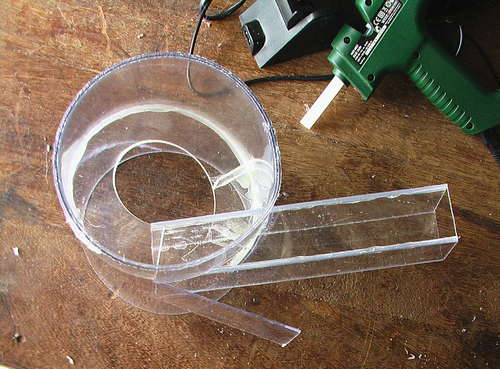
The air ramp continues the downwards angle of the inlet. It ensures that the air does not whiz round and hit into the backside of the inlet, or the new air continuing to stream in,(both of which would be a cause of turbulent badness).
Making the cyclone’s ‘Air Ramp’
For the air ramp use 1.5mm thick polycarbonate. The air ramp size must be bigger than the diameter of the upper body, because it is stretched out in a spiral when it fits inside. The diameter is calculated with a crazy maths type equation from this website: http://www.math.cornell.edu/~dwh/papers/EB-DG/EB-DG-web.htm
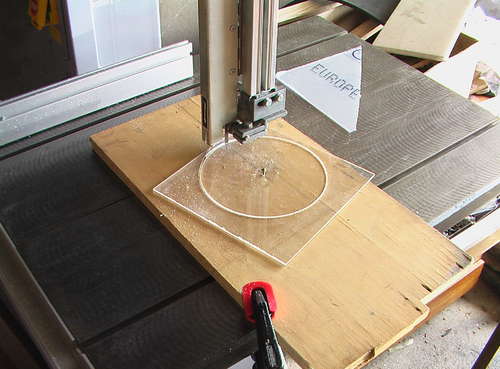
The air ramp can be cut out on the bandsaw using a simple circle cutting jig (you will need a circle cutting jig of some sort – even if it is as simple as this ‘screw in board’ affair). As the outer ring is not continuous, you can get in and cut the inside circle with the bandsaw blade.
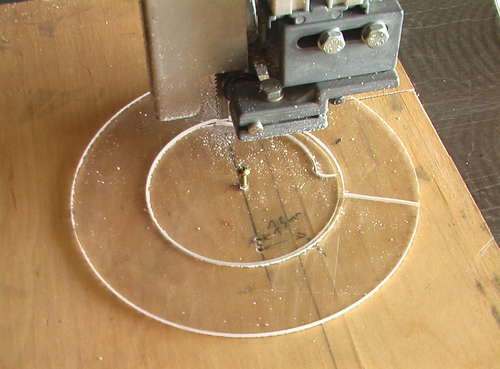
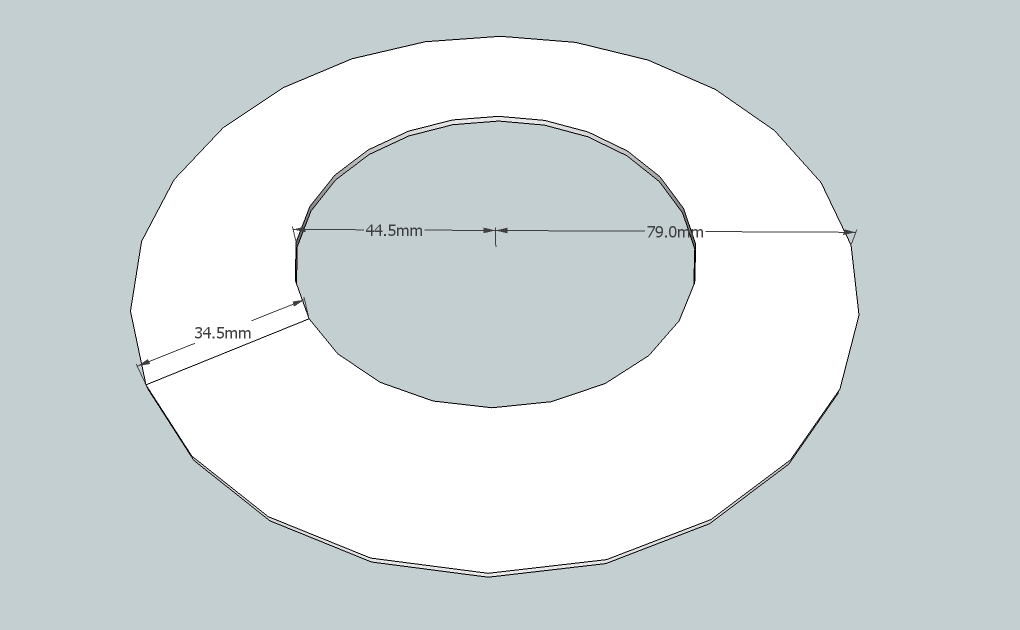
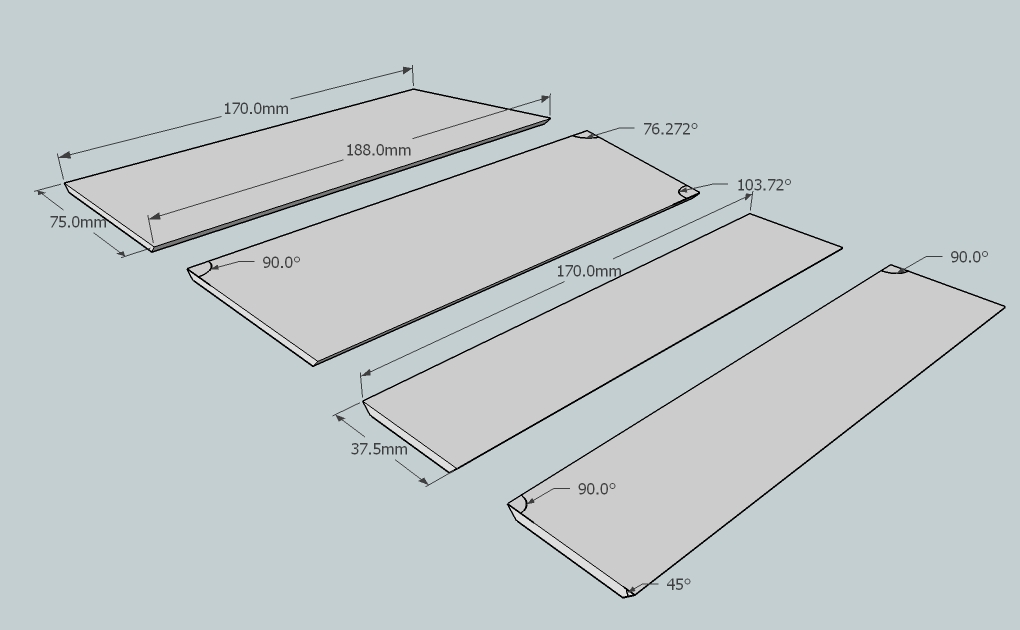
Here is the cyclone’s ‘air ramp’ cutting diagram and measurements (click for a closer look).
Making the cyclone’s ‘Air Inlet’
For the inlet I used 3mm thick polycarb. To make the air inlet it is useful to cut with a bevel edge of 45 degrees. That way when it is in use the suction force on the inside of the inlet, rather than weaken the join (as it would in the case of a standard butt joint), actually strengthens it.
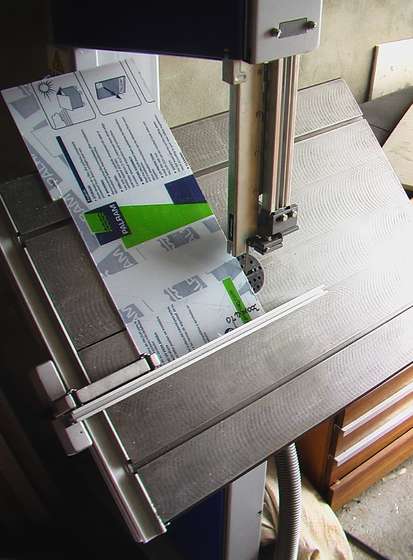
One way to get the correct entry angle, is to cut the whole thing after gluing it together. This might seem easier than working out all the individual lengths (but I have now done this for you – see diagram further down), but is a bit risky because the violent action of the bandsaw can damage joints. After getting the angle right, it is ready to be put into the upper body (see next step).
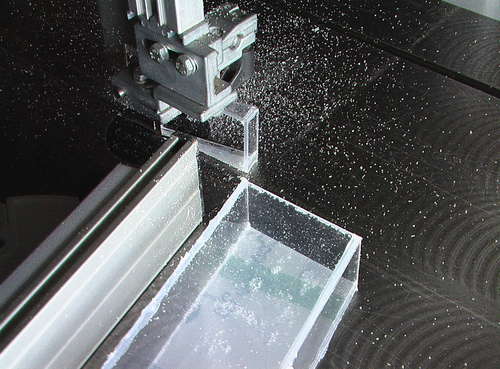
The inlet’s cutting diagram (click to enlarge)
Another reference image, just to show how the ramp and air inlet fit in combination with the cyclone body.
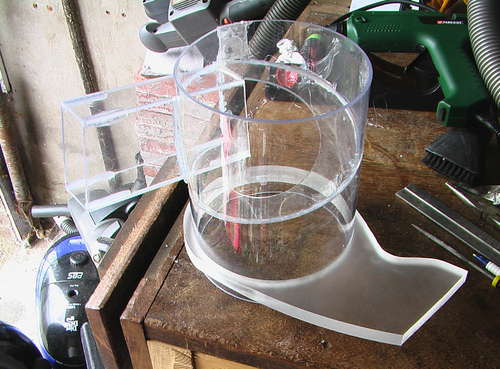
And that’s it, the air ramp and inlet are ready for mounting in the cyclone upper body which we are about to make.
April 10th, 2014 at 3:05 am
I’ve tried to understand the fuzzy-math. (oops, crazy math.) equation from the link that you provided; however, I’m getting old and cannot figure out what number to use for “p”. Perhaps you could help me. I’m using a 12″ high cylinder with an I.D. of 7.5 inches. Inside this will be a tube with an O.D. of 2″. I need to figure out the radius of the circle that I need to cut out for the strake (air ramp). Can you show me the math. (equation & numbers) so that I can try to understand it? Thank you.
October 2nd, 2014 at 12:39 pm
P=3,14
The length of the periphery is equal to 2*p*r=2*3,14* r, r is for radius
October 3rd, 2014 at 1:53 am
Basil,
Thanks for responding, but I’m still confused. Where did you get the P=3,14? Or better still…
Could you do me a favor and use my numbers in my first posting in the equation that it referred to in the paper, and I quote:
“If R is the radius of the cylinder and H is the height of one turn of the helix, then the curvature of the helix can be computed to be 4pi2R/[H2+(2piR)squared]. Ach, the program here won’t let me use the symbol for pi or squared. In the case of R = 1m and H = 10m, this gives us r = 3.533m.”
When I attempt to plug in my numbers I get a ridiculous outcome. I know that I must be doing something wrong, but I’ve got one foot on a banana peel and the other creeping toward the grave, and I just don’t get it…better yet, could you do the calculations for me so that I can get this project going? I’ve got all of the parts. I just need to figure out the ramp part.
Much appreciated. Thank you.
Cliff.
February 13th, 2015 at 3:52 pm
In know it’s an old post, but just in case someone comes across it like I did.
P=3.14
The number π is a mathematical constant, the ratio of a circle’s circumference to its diameter, commonly approximated as 3.14159. It has been represented by the Greek letter “π” since the mid-18th century, though it is also sometimes spelled out as “pi” (/paɪ/).(EXCEPT IN THE CASE OF CORNELL UNIVERSITY CRAZY MATH)
They just use p ;)
February 13th, 2015 at 6:32 pm
Bill B,
Thank you for your explanation :-) My post may be old, but I’ve been sitting on this all the time. I was a victim in a rather nasty car wreck some 5 years ago, and I simply have difficulties now working with some problems
Cliff.